

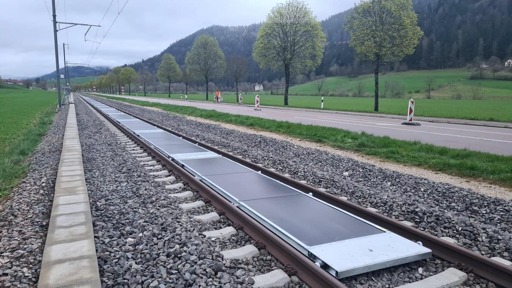
Out of all places where you could possibly place a solar panel, this seems to me like one of the least practical ones. It’s almost all drawbacks
Even just a foot to the left and to the right, they can install double the number of panels while avoiding most of the downsides.
Three years ago EEVBlog already published a Video why this is a terrible idea: https://youtu.be/7vItnxhWRqw
Im not convinced much has changed since then. As a Swiss citizen it’s a bit disappointing that a apparent cash grab like this is possible.
Crazy cheap deployment, but I don’t think those panels will stand up to it very well. The vibration is bad enough, but metal fragments are the real threat, I suspect. I’ve been in a few rail yards, and vehicles that habitually get parked close to rails that are in active service have paint damage from tiny metal chips flying off the rails and wheels. Unless they have some kind of replaceable clear shield, those panels will not just get dirty, they’ll get slowly sandblasted till not much light is actually reaching the photovoltaic panel.
Also if it’s a cargo train things fall off all the time. Walk along a train track and you will find a bunch of stuff
Sometimes a body

Really long and thin strips that can’t be angled. They can only be serviced while the track is closed and need to survive whatever debris a train might fling at them. Is this really the best way to place them?
Solar freaking railways.
They can only be serviced
I don’t think this should be a concern, I’ve had them on my roof for 3 years now and not touched them once
Is this really the best way to place them?
Seems so:
But this is just a pilot program. If the system works safely on a busy rail line, it could point to a new way of expanding solar power without covering farmland, forests or mountain slopes with panels. That’s perhaps important in Switzerland, more so than in other places, where renewable energy is urgently needed, but new solar projects can face resistance when they move into cherished landscapes. NIMBY is sadly a global phenomenon.
For the life of me I don’t understand why people are putting them anywhere before every rooftop is covered with them. Roofs are dead space and unlikely to have debris issues (at least compared to a railway).
Or in parking lots. It would also have the added benefit of providing cover for cars.
Every parking lot needs approval of the location, its probably a a pain in the ass, and would disrupt parking while being built which impacts sales (or will be perceived to anyway). If this worked, you only need to deal with a small group of people for a very large space.
I don’t think they’re a lot of surface parking on Switzerland like in the US
I do occasionally see parking lots with solar here in LA! So it is happening in some places.
It’s companies trying to make a quick buck. They tried this with roads too.
Obviously every home should have them first and all newly built homes should be built with solar efficiency in mind.
Deployment on rails is dirty cheap. Can be highly automated and you have highvolt power line just a few meters away.
If you put solar upon your roof, 2/3 of the costs are labor costs. The material bill encompasses electrics, mounting system, cables, and pv panels that can get reduced on railways as well.
Cheap if you only count the cost of plopping them down and walking away, the train could kick up enough dust and debris that efficiency is impacted significantly more than installing them on a roof would have been, necessitating installing new ones sooner.
It’s all theory. That’s why I think it’s worth a try and learn the facts.
Edit: A rough estimation with averages: 10 kWp gives 11kwh a year in Swiss, 1kwp panel costs 500€, 1kwh energy costs 0,28 EUR in Swiss. Panel material costs for 10 kWp is 5,000€ and earns you 3,080€ (11,000*0,28€) yearly. This shows the value of the idea.
What if the train runs a street sweeper brush behind it to clean them off every time?
Yes exactly, it makes no sense!
There’s literally gravel beside them in the picture that’d be a better spot 😭
It seems like the sort of naive gimmick one might expect from a MAD Magazine cartoonist, or Elon Musk on a ketamine binge. It would work to an extent for a while, though whether the amount of electricity generated would justify the maintenance costs to keep it going is another matter.
The arguments against it are the power yield of a panel pointing upwards, and presumably covered with dirt shed by passing trains. That said, it would suffer less impact damage than photovoltaic roads/bike paths floated elsewhere (the occasional rock impact, as opposed to constant traffic). Also, there is a lot of track, so even if a segment generates little power, it adds up. Not enough to power electric trains, though possibly enough to offset the power bill after operating costs are taken into account.
I’m guessing this installation is an experiment to quantify these figures rather than a commitment to roll this out more broadly.
I’m guessing this installation is an experiment to quantify these figures rather than a commitment to roll this out more broadly.
No need to guess, it’s right there in the article.
The whole point of the exercise is to put solar panels in the not best location. Otherwise this article would be about wireless power transmission from space.
It’s stupid and genius at once. So, worth a try.
More info: https://www.groupe-sncf.com/en/innovation/solar-power-between-rails
The company behind it seems to have already tried it a year ago, and the project is in pilot phase until 2028
I too am launching a pilot program that will last until I’m of retirement age.
Gadgetbahn type shit
Switzerlands rail network is around 5300km long (source) if you cover around 50% of it, that gives roughly 500MWp installed capacity. A modern locomotive has 4-8MW. That gives you enough energy to power 80 locomotives under full load. I expect them to use much less power once in motion so it may be more in reality. That’s not nothing.
Does that figure account for the 90% power loss from pointing straight up?
Not to mention the constant dirt and debris, snow, tiny scratches and cracks from the high speed trains throwing metal shavings, rocks, random dropped bolts, grease, and everything else onto their surfaces?
Building a platform above the trains at whatever height the lowest bridge on that route is would allow them to change angle to track the sun, and keep them better protected
Clever use of land.
For fucks sake, raise them above the track and angle them towards the sun.
“Researchers in Switzerland suggest almost wiping your ass in first-of-its-kind test”
We could use the railing to transmit power but nah we have to use it to house power source
That’s already the standard in Switzerland. The overhead line is the phase and the rails are ground.
In what world is it reasonable to put a several kilovolt line on the ground? Even subways have safety problems with the third rail.
Damn you want kilovolt? I was thinking few hundred at most. Over a few miles it would be fine to power like lights and low powered devices
There is usually a current present in the rails already
Either traction current, signalling current for track circuits, or both
Depending on the way the signalling system has been engineered
Hmmm neat. I guess those are high voltage signals
Definitely not
Sometimes in the order of mere milivolts
It’s a nice thought but boy will it be a bummer when a single loose hook or bolt destroys like a hundred miles of renewable electrical infrastructure
Who cleans the snow off?
Wind from trains? Maybe an attachment that brushes them off occasionally.
This just seems silly
Silly Swedes…
Morons! Morons everywhere!