
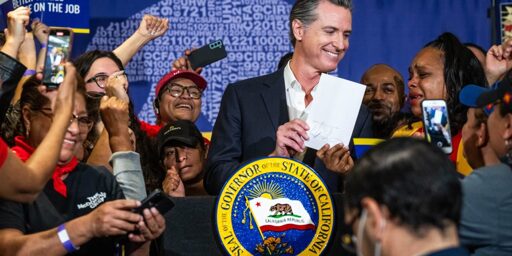
Following California implementing a law raising its minimum wage to $20 for more than 500,000 fast-food workers in the state in 2024, Christopher Thornberg, founding partner of research firm Beacon Economics, offered a warning about the state raising its minimum wage.
“California’s well-intended push to reduce income inequality via wage floors is beginning to have a significant negative impact on some of our most vulnerable workers—our youth, particularly those from lower-income households,” he wrote earlier this year.
His concerns echoed those of fast-food franchise owners, one of whom told Fortune in 2024 that higher wages would be unsustainable for smaller chains with slim margins.
But nearly two years after the law’s passage, economists are seeing very different results than what was initially feared. A working paper from University of California at Berkeley released this month found the policy increased average weekly wages for eligible workers by 11% and did not reduce employment. Prices increased modestly, about 1.5%, or the equivalent of about six cents for a $4 item.
The problem with Economics is that most Economists are first and foremost Propagandists, the most “important” the positions they hold, the most likely that’s the case: nobody gets made head of a Central Bank, a permanent commentator in the Press or gets a gold plated job at a Think Tank, for defending scientific theories which go against the interests of the power elites of a country.
So whilst there’s quite a lot of Science in Economics (especially Behavioural Economics), the most visible, highly paid, loudly praised in the Press, award-winning (most notably with the “Swedish Central Bank Prize for Economics in honor of Alfred Nobel”, commonly portrayed as a “Nobel Prize” for Economics) “Economists” are so distant from any Scientific Principles that they’re pretty much anti-Science.
Unsurprisingly, with the prestigious, most well paid and most visibly positions in it being dominated by greedy charlatans working as paid minions of the powerful, the discipline has a very bad name.
easy fix…just ban places like mcdonalds and whatnot from operating in the state… tell him kick rocks. they don’t pay taxes anyways and they spend that money instead to fight to have slave wages remain, and work to strip rights from workers. why are they useful again? let those companies die in the filth they created for once.
I’m confused on your posted fix here. As cited in the article many fast food employers are already paying over minimum wage so they wouldn’t be hit hard by a minimum wage increase. The only reference to any specific category of fast food employers that would struggle with a minimum wage increase in the article was “smaller chains”. I doubt Mcdonalds would fall into that category.
So what is accomplished with your proposed fix of banning McDonalds from the state?
A reduction in monopolistic capitalism and an increase in independent businesses.
We need way more competition.
Why are we having to repeat all the lessons learned in the early 20th century? Oh right, because the right has been gutting education forever.
Interesting POV. Honestly have never considered that there could be such a benefit from locking out corporations.
who do you think operates the mcdonalds locations?
A reduction in monopolistic capitalism and an increase in independent businesses. We need way more competition.
How big does a company get before it would get the “non-independent business” label barring it for operation in California under your proposal? Are you thinking a ceiling on net revenue, number of employees, or number of physical locations in the state?
Any of the above, but a reasonable combo of those is probably best.
Any worry that if you’re restricting businesses from growing that you’d also be sacrificing economies-of-scale that work to drive prices down?
No.
If this is your belief, can I ask if you’re living it today? Do you eschew any mass produced goods and instead purchase only goods made by artisan craftsmen? If not, why not if its the superior way?
Historically, the lowering of prices have come as a detriment to the consumer. Be it lower wages for workers, less benefits for workers, difference in quality of materials, quality of creation, quality control to let lemons through, exploiting vulnerable work forces elsewhere. Rarely has it resulted in a better product or service.
I think you’re confusing symptoms of late stage capitalism with economies of scale.
Do you honestly think that handmade goods only by craftsman should be the exclusive way we have goods made?
A reminder that while we need to fight for higher minimum wages (or simply a broader safety net for all, which is a far better solution for workers), the $15 target for most places, the $20 for California, is still far below what a reasonable living wage would be had wages kept up with inflation and productivity earnings for corporations starting in the 70s. They’re holding us down at decade-old amounts, making us fight for minimums that are about half of what’s needed, letting us win occasionally to think we’ve made progress.
It’s also why discussions of how expensive things are can be misleading. Taking inflation and wage comparison into account, some costs are where they should be given normal change over time, while wages have stagnated.
Isn’t the living wage somewhere around the $30 mark now? I make roughly that and it feels like I’m floundering at times.
in california? depends on the part. bay area/la is more like 40, sacramento 30ish, rest of the state 25. estimates from doing taxes this year.
It depends. Cost of living and other factors.
Note that the minimum wage level is called the poverty wage here.
I think any sort of basic income effort would have to have a base federal level to meet all areas, and then state and county additional amounts to account for the cost of living differences.
Ohh, nice, thank you for this. Though I am not sure I like the cost of living being lower because of geography. I feel incomes should be across the board with minimal difference. I’m still doing the same level of work as someone in a smaller town. They shouldn’t make less because of such factors.
If the goal is to level the playing field (upwards), then maybe that would be more fair. Turn it around, why should you be making less than them because of location? You said you felt like you were just getting by, right? Maybe your wage is the correct wage for a rural town.
If a person moves to a new location/job, the wage would adjust for that area.
As things currently are yeah, wages do need to change depending on CoL in specific areas.
Reality I feel wages should be flat for that position. If I’m in Nebraska I should still make let’s say $60K which is what someone in a city would make for a similar position. Just feels the current system brings more reward to live in a large city and results in essentially states with veritable ghost towns because they’re more rural.
They aren’t wrong, they’re lying. Economists are the academic spokesmen for business interests.
Hey come on it’s only most of them.
Prices increased modestly, about 1.5%, or the equivalent of about six cents for a $4 item.
I’m happy to pay a little bit extra for a meal when it’s going to the workers’ wages. And considering how restaurant prices in CA (and elsewhere) have skyrocketed over the last few years, it’s clear this initiative made up only a tiny portion of that overall increase. The rest, presumably, being caused by inflation, supply chain issues, and general corporate greed (among other factors).
I’ll tack on the corporate landlords pricing out businesses as well. Some businesses might not have jacked up prices so much if they didn’t have sky-high rents. Imo, corporations should be leasing land from the government; there doesn’t necessarily need to be private ownership of these commercial properties.
Economists are by and large the worst for making predictions, because they’re social scientists who think they’re mathematicians. Not sure I’ve ever seen an economist ‘warning’ about the implementation of left wing ideals turn out to be right.
just because they can do a little statistics we shouldn’t make too much fun. well okay we should but we need to know the right lingo: they have ignored the general equilibrium issues you can pretty much just say that and be right
52% favor the billionaire tax? Jesus Christ! Only 52%! It’s plain fucking logic! What is wrong with people?
Just a guess but its probably two groups in opposition:
- “temporarily embarrassed millionaires” who think they need to protect their future income
- those that think the fantasy of “trickle down economics” actually works and that enacting this measure will drive out billionaires leading to lower income for those that are not rich
This happens every single time.
Money flows from the bottom up, because the poor have no choice but to spend it.
Why would I want to operate a business in a place where people have money to spend?
Never trust a word that comes out of chris thornbergs mouth. Beacon economics is a handful of hacks who say whatever gets Chris the most attention.
If track records mattered to economists, then Paul Krugman would be making minimum wage by now.
I think this is because they’ve already raised prices to the hilt in California. Consumers aren’t willing to pay more for fast food than they’re already charging.
No. Prices are already up everywhere except wages.