

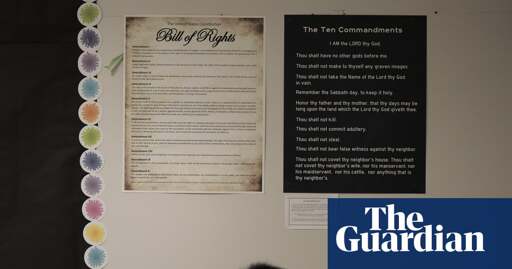
Texas can require the Ten Commandments to be displayed in public school classrooms, a US appeals court ruled Tuesday in a victory for conservatives who have long sought to incorporate more religion into schools.
It sets up a potential clash at the US supreme court over the issue in the future.
The fifth circuit court of appeals said in the decision that the law did not violate either the establishment clause or the free exercise clause of the first amendment.
The law is among the pushes by Republicans, including Donald Trump, to incorporate religion into public schools. Critics say it violates the separation of church and state while backers argue that the Ten Commandments are historical and part of the foundation of US law.
Is anyone with a legal background able to explain how this does “not violate either the establishment clause or the free exercise clause of the first amendment”? It certainly seems like it would. Edited for clarity.
The Establishment Clause is literally the opening portion of the First Amendment, before it goes into freedom of speech, assembly, etc.
The conservatives generally argue that not allowing things like this is a prohibition of the free exercice of religion.
Think of it in the same sort of reasoning that restricting a business organization (such as a corporation) from controlling who frequents their establishments or whether they spend their earning on political donations is a restraint of their freedom of speech.
You might argue that allowing for that leads to clear and swift problems but they argue that the text doesn’t actually say those rights shouldn’t belong to those groups (and the originalists argue that’s actually, even, what the original authors have in mind; I’d argue the opposite is true but when has something like evidence stopped them…).
You would think not respecting an establishment of religion would be interpreted as a separation of church and state but I think they argue that it means (somewhat) that gov. can’t regulate any religious establishment (I think; I’m not as familiar with that part).
Basically, they think the First Amendment protects only the exercise of religion, even if that practice manages to restrict the exercise of other religions; the government can’t step in to do anything about that: because that would restrict the religious rights and exercise of the first religious group (unless, of course, the second group were Christian; suddenly, then, I suspect they’d understand).