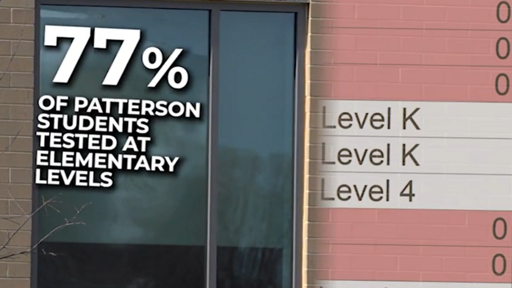
BALTIMORE (WBFF) — A Baltimore City teacher came forward with devastating information that showed 77% of students tested at one high school are reading at an elementary school level. The teacher works at Patterson High School, one of the largest high schools in Baltimore with a 61% graduation rate and a nearly $12 million budget. We agreed not to identify this source who fears retribution for giving Project Baltimore the results of iReady assessments. “Our children deserve better.
I mean this is a real issue. Americans largely cannot read. The average for adults is roughly a 6th grade level. English majors cannot interpret Dickens
Probably the most alarming index of this was a study in which a group of English majors at two well-regarded public universities in Kansas were asked to read the first seven paragraphs of Bleak House by Charles Dickens, and explain after every sentence what they thought was happening. Only 5% of the students could produce a ‘detailed, literal understanding’ of the text. The rest were either patching together vague impressions from a bunch of half-understood phrases, or could not comprehend anything at all.
One particular stumbling block was the novel’s third sentence, which describes London in December: ‘As much mud in the streets, as if the waters had but newly retired from the face of the earth, and it would not be wonderful to meet a Megalosaurus, forty feet long or so, waddling like an elephantine lizard up Holborn Hill.’ The students found this figurative language impossible; they could only read the sentence with the assumption that Dickens was describing the presence of an actual prehistoric reptile in Victorian London. One respondent glossed it like this: ‘It’s probably some kind of an animal or something or another. So, yup, I think we’ve encountered some kind of an animal these characters have met in the street.’ The study assessed this person as a ‘competent’ rather than a ‘problematic’ reader, because they’d at least managed to form an idea of what the text meant, even if it was wrong.
Bleak House is not an elitist text; not so long ago, it was mass entertainment. When Dickens visited America in 1867, over 100,000 people paid to see him speak. Delighted crowds mobbed him in the streets. Today, a person studying English literature at degree level responds to his work in essentially the same way as an illiterate Uzbek peasant in the 1930s, incapable of thinking outside of immediate sensory reality.
One particular stumbling block was the novel’s third sentence, which describes London in December: ‘As much mud in the streets, as if the waters had but newly retired from the face of the earth, and it would not be wonderful to meet a Megalosaurus, forty feet long or so, waddling like an elephantine lizard up Holborn Hill.’
On one hand, I had to read this a couple times. On the other hand, I’m a mechanical engineer whose primary language isn’t English and my main English tutor was Breath of Fire III on psx.
I had to read it through twice to fully grasp it. It helped knowing it was Dickens’ writing. The language has changed a little in 160 years, some of those words don’t have the definitions Chuck was using them for anymore. “It would not be wonderful to meet a Megalosaurus”, for example. In Dickens’ day, words like “wonderful” and “fantastic” and “marvelous” meant magical or amazing, today they simply mean very good or excellent. A modern writer would say “You wouldn’t be surprised to see the Loch Ness Monster flopping around like a beached whale” to mean what Dickens is saying here.
This is largely why I’m against handing teenagers the untranslated works of Shakespeare. We don’t do that with Chaucer, teens aren’t expected to read The Canturbury Tales in its original Middle English, they may be read small passages so that they can hear what it sounded like, but then to study the content of the work, translate it into Modern English. You might do the same with Shakespeare, have them study an entire play in modern English, and then show them scenes from a performance of the play in it’s original Ye Olde Josse Whedone.


I mean this is a real issue. Americans largely cannot read. The average for adults is roughly a 6th grade level. English majors cannot interpret Dickens
Since you mentioned Dickens :
On one hand, I had to read this a couple times. On the other hand, I’m a mechanical engineer whose primary language isn’t English and my main English tutor was Breath of Fire III on psx.
I had to read it through twice to fully grasp it. It helped knowing it was Dickens’ writing. The language has changed a little in 160 years, some of those words don’t have the definitions Chuck was using them for anymore. “It would not be wonderful to meet a Megalosaurus”, for example. In Dickens’ day, words like “wonderful” and “fantastic” and “marvelous” meant magical or amazing, today they simply mean very good or excellent. A modern writer would say “You wouldn’t be surprised to see the Loch Ness Monster flopping around like a beached whale” to mean what Dickens is saying here.
This is largely why I’m against handing teenagers the untranslated works of Shakespeare. We don’t do that with Chaucer, teens aren’t expected to read The Canturbury Tales in its original Middle English, they may be read small passages so that they can hear what it sounded like, but then to study the content of the work, translate it into Modern English. You might do the same with Shakespeare, have them study an entire play in modern English, and then show them scenes from a performance of the play in it’s original Ye Olde Josse Whedone.
Welp, I’m dumb. I don’t know how to interpret it either.
Does this mean London is dry? Or muddy? Or nothing to do with mud?
What does a muddy or dry climate have to do with a dinosaur?
I think the dinosaur part is in reference to how muddy and trampled the ground looks.
That it looks as if a dinosaur waddling like an elephant had come through
Well, that’s embarrassing. These are people studying at university level? :,D