

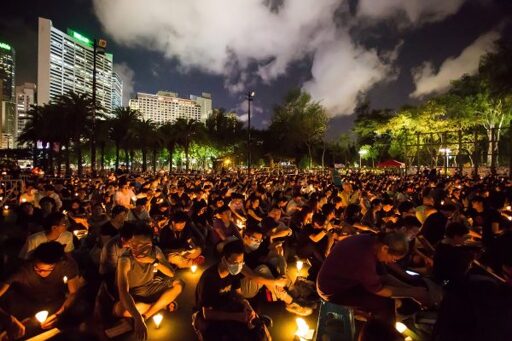
cross-posted from: https://lemmy.sdf.org/post/54184510
Op-ed by Rowena He, research fellow at the Hoover Institution at Stanford University and author of “Tiananmen Exiles: Voices of the Struggle for Democracy in China.” As a scholar of Tiananmen, she was denied a work visa to return to her associate professor position at the Chinese University of Hong Kong.
“They won’t let us go to Wan’an Cemetery.” Days before the 35th anniversary of the Tiananmen Massacre, members of the Tiananmen Mothers were informed by the Beijing Municipal Security Bureau that they would be barred from visiting the graves of loved ones killed in 1989.
For over three decades, Wan’an Cemetery served as the sole sanctioned space where grieving families could mourn together each June 4 – though always under heavy police surveillance. When I showed footage of the cemetery grounds to my Harvard freshman class 15 years ago, my students were stunned to see surveillance cameras deliberately installed over the burial sites of Tiananmen victims. Even the headstones told a story of fear: many originally omitted “June 4” as the date of death, with families adding it only years later.
[…]
Many of the student protesters who survived are now parents themselves, but the repression has only intensified. After allowing these heavily monitored cemetery visits for more than 30 years, the regime that killed their children is now depriving the Tiananmen Mothers of even this final act of remembrance.
In spring 1989, the sudden death of Hu Yaobang – the reformist Communist Party general secretary who had been purged for his sympathetic stance toward the 1986-87 student movements – sparked massive protests across China. Students, joined by workers and citizens nationwide, took to the streets demanding democratic reform and an end to corruption. The peaceful demonstrations, highlighted by college students’ hunger strike in Tiananmen Square, ended on June 4 when the regime deployed over 200,000 People’s Liberation Army soldiers, equipped with tanks and machine guns, to assault its own people in the capital.
[…]
Even today, the full scale of the massacre – including the death toll – remains unknown. The mother of Yuan Li, a 29-year-old engineer who had been accepted to graduate school in the United States, searched 44 hospitals and saw over 400 bodies before finding her son at the Navy General Hospital. In her testimony, she described the day Yuan Li was cremated: she saw two large plastic bags emanating terrible smells, filled with corpses. “If death tolls are ever counted in the future,” she testified, “these poor children will remain nameless bodies.” Yuan Li is buried in Wan’an Cemetery.
[…]
The fear created by the massacre is best illustrated by a story shared by Professor Cui Weiping, the Chinese translator of Vaclav Havel’s “The Power of the Powerless.” After one family’s 28-year-old son was killed, the victim’s sister was abandoned by her boyfriend after he learned about her brother. When she later entered a new relationship, that man also left her upon learning about her family’s history. She and her mother made a painful decision: she would never mention her brother to anyone she planned to date. She eventually married and had a son. Neither her husband nor her child knows about the death – or even the existence – of this brother-in-law and uncle.
[…]
Knowing the delegitimization the massacre would bring, the regime constructed an official version of the 1989 events in the immediate aftermath of the military crackdown, even as arrests and purges continued nationwide.
[…]
Information collected by the Tiananmen Mothers, however, reveals that many victims had never joined the protests and never confronted the troops. Ma Chengfen, a veteran of the People’s Liberation Army, was shot and killed while sitting on the steps of her building chatting with neighbors. The youngest known victim, 9-year-old Lü Peng, was shot in the chest. The oldest, age 66, was killed inside a hutong while visiting relatives.
[…]
Two locations saw especially heavy casualties. At Muxidi, soldiers opened fire on crowds as troops entered the city. At Liubukou, tanks chased down students who had already peacefully evacuated the square and were heading back to their universities. Among them was Fang Zheng, a senior at Beijing Sports College, whose legs were crushed by a tank as he tried to push a freshman student walking beside him to safety.
[…]
The Tiananmen Mothers have been demanding truth and justice, resisting the official accounts imposed on them. In 2006, the group called for “truth and reconciliation.” The mother of Ya Aiguo, shot in the head and killed at age 22, questioned: “”Why did you use real guns and bullets on your people? Even if you kill a chicken or a lamb, you should apologize and compensate, right? Such a big China, such a big CCP – you killed my son, but you didn’t even say sorry. Are we citizens not allowed to say a word?”
[…]
Then COVID-19 hit, and a White Paper Generation emerged three decades after Tiananmen, despite the elaborate Patriotic Education Campaign in post-1989 China that gave rise to “wolf warrior” nationalism […] After witnessing firsthand how the accounts of China’s COVID-19 experience that they had personally lived through were being reconstructed into a distorted official version of national memory, this new generation wanted to know what else they had been deceived about.
[…]
In the early 1990s, when I was a college student, on each June 4 my friends and I would light candles behind closed doors and shuttered windows. They cannot extinguish the candlelight in our hearts.
“People will one day put you on trial.” In 1989, this banner hung from the top of a major building at Renmin University of China. Those who ordered the massacre will not only be tried by the people, but also by the history they tried to suppress with power.
History is on our side.
Are you aware that videos are made up of many images shown in sequence to give the illusion of motion?
Read the rest of it, especially the part where “this account aligns with our current understanding.”
They actually do. The “massacre” narrative is that “big bad even Chinaman gunned down innocent children for no reason other than their undying love of democracy!@!@3!!”
Their account is that soldiers were being brought into the red cross with gun shot wounds.
This destroys the narrative you people are paid to paint.
That’s not the claim made by the propagandaist Jeff whatever the fuck. He claims he took a photograph, and was given awards based on his photograph.
Not only did he not take a photograph, he obtained a still image from a video someone else took of a man attempting to prevent the tanks from leaving the square after the police had resolved the situation; and then spun that as “tank threatens man” or sometimes “brave man stands against tank entering square” when it was the exact opposite situation.
I guess we can agree that many people, probably hundreds, were killed.
That’s not something I, or anyone else here has said. Stop inventing strawmen.
Again, you know that videos are made up of many images, right?
And you know that more than one person recorded the moment, right?
https://en.wikipedia.org/wiki/Tank_Man